

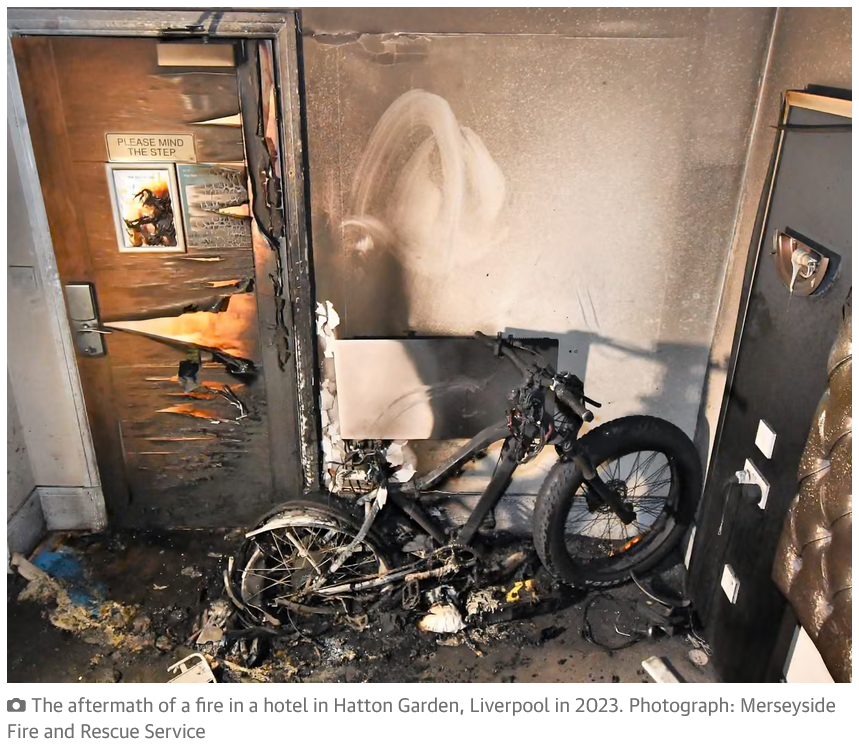
Image pulled from The Guardian news item here
There is an idea floating around the bicycle industry that independent bike shops should be trying to service almost every e-bike that comes through the door. The argument sounds compelling. There are millions of e-bikes out there, huge numbers were purchased online or from big-box stores, and eventually a whole bunch of them are going to break and are breaking now - or worse - burning down houses. Meanwhile, independent bike shops are complaining about declining bicycle sales and looking for new revenue. So here comes this enormous population of machines desperately looking for somebody to fix them.
Opportunity!
We’re leaving money on the table!
Train the mechanics!
Embrace the future!
Except I think we’re confusing unmet demand with profitable demand, and those are two very different things.
Before I go any further, I’m not some grumpy old bike-shop guy who thinks electricity ruined bicycles. I’ve sold e-bikes for years. I’ve ridden 10’s of thousands of kilometres on them. I ride one back and forth to work almost every day. I think a good electric bicycle is one of the most useful transportation tools we’ve invented in decades. They replace car trips, flatten hills, shrink distances and allow people who haven’t ridden in twenty years to start riding again.
I love e-bikes. They are truly a game changer.
What I’m increasingly less enthusiastic about is the giant pile of electric shit we’ve decided also gets to be called an e-bike — and the strange assumption amongst some of the “old guard” in the biz that independent bicycle shops are somehow responsible for keeping all of it running.
MAYBE THE MARKET IS TRYING TO TELL US SOMETHING
I run a bicycle shop in Calgary, a city of roughly 1.5 million people. There are a lot of inexpensive e-bikes here purchased from Amazon, big-box stores and direct-to-consumer companies. When I ride around the city the vast majority of the e-bikes I see people riding are clearly not being purchased from local bikes store. Yet, as far as I can tell, there are perhaps one or two shops in the entire city that will even maybe attempt electrical repairs on the broad universe of unsupported e-bikes - or e-shit as I like to describe most of them.
Think about that. Thousands of potential customers. Almost no competition. An apparently enormous and growing need for service.
If repairing these things is such an amazing business opportunity, where the hell are all the repair shops?
Maybe every existing bicycle shop in Calgary is stupid.
Maybe we’ve all looked at a giant pile of money sitting on the sidewalk and decided we’d rather not pick it up.
Or maybe the market is trying to tell us something.
Independent bike shops are pretty good at finding ways to make money because the alternative is going out of business. If dozens of businesses independently arrive at roughly the same conclusion about a supposedly lucrative category of work, perhaps we should spend a little less time telling them they’re afraid of change and a little more time asking what they know.
DIAGNOSING SOMETHING ISN’T THE SAME AS FIXING IT
One argument is that bicycle technicians simply need better electrical diagnostic skills. Fair enough. Modern technicians absolutely need to be comfortable with electronics. E-bikes aren’t going anywhere.
But diagnosing a failed controller doesn’t magically make a replacement controller appear on the workbench.
Who made it? Can I buy one? Is there a Canadian distributor? Is the manufacturer still in business? Does the connector match? Does it communicate with the display? Is there a wiring diagram? Is there anyone I can call when the replacement doesn’t work?
And after we’ve spent an hour figuring all this out, who pays for that hour when the answer is ultimately, Sorry, we can’t get the fucking part?
Professional service departments depend on reasonably predictable outcomes. Bike comes in. Problem gets diagnosed. Part gets ordered. Bike gets fixed. Customer pays. Bike leaves.
The further you move away from supported products with available parts, documentation and technical support, the less predictable that process becomes.
And unpredictability eats money.
SHOP CAPACITY ISN’T FREE
This is what gets lost when somebody calculates the theoretical revenue available from millions of broken e-bikes. Every independent bicycle shop has limited capacity. There are only so many workstands, technicians and hours in the day. There is only so much room to store 75-pound bicycles waiting months for mystery controllers. And there is only so much mental energy available for emailing some company you’ve never heard of before everyone in the service department starts hitting the bong before lunch.
The relevant question isn’t, Can we make $200 fixing this e-bike?
It’s whether this is the best use of two hours of one of the scarcest resources in the business.
Because while my technician is reverse-engineering an unfamiliar electrical system, they’re not replacing brake pads on somebody’s commuter, rebuilding a touring bike before a big trip or knocking out three straightforward repairs where the parts are already in stock and the bikes will actually leave the building tomorrow.
Turning away work doesn’t necessarily mean turning away revenue.
Sometimes it means protecting your ability to do profitable work well.
THE CUSTOMER ISN’T THE PROBLEM. THE ECONOMICS ARE.
This part requires some care because it’s easy for bicycle shops to sound like assholes complaining about people buying cheap bikes. Times are tough. We know. We feel it personally and we see it everyday as we struggle to keep our doors open.
I don’t blame someone for buying what they can afford. If you’ve got $1,500 for transportation and somebody offers you an e-bike for $1,399, buying it might be completely rational.
The problem comes when professional repair collides with the economics of an inexpensive product.
Suppose diagnosis, sourcing a controller, buying it and installing it produces a $500 bill. On a $6,000 e-bike that’s painful. On a $1,300 e-bike that’s nearly 40 percent of what the entire thing cost.
The customer may quite reasonably say, Fuck it, I’ll buy another one.
They’re not being cheap. They’re being rational.
Unfortunately, my shop has already consumed the technician time required to discover that the repair doesn’t make economic sense.
That’s why millions of inexpensive e-bikes don’t automatically mean millions of profitable service jobs. Demand for repair is not the same thing as willingness to pay the actual cost of professional repair.
Nobody operates a thriving neighbourhood toaster repair business. It’s not because humanity forgot how to fix toasters. It’s because eventually it became cheaper to throw away the toaster.
What I see is a massive proportion of the e-shit market is operating much closer to the economics of consumer electronics than actual bicycles. Which is pretty fucking depressing considering one of the bicycle’s greatest virtues has always been that you can keep the thing running for decades with a few simple tools.
WHO EXACTLY IS GOING TO DO ALL THIS WORK?
There’s another tiny detail in the plan to have bicycle shops repair everything with a battery and pedals:
Technicians.
The bicycle industry has struggled for decades to recruit and retain skilled mechanics. A good modern mechanic already needs to understand hydraulic brakes, electronic shifting, suspension, wheel building, internal gearing, carbon components, mechanical drivetrains, firmware, diagnostic software and supported electrical systems like Bosch and Shimano. Some people already balk at the labour rates we have to operate at to stay in business.
Now we’re going to add electrical troubleshooting across a nearly infinite collection of motors, controllers, displays, batteries and wiring harnesses from companies nobody in the city has ever heard of.
At some point we’re no longer describing a bicycle mechanic.
We’re describing a fucking rocket scientist.
And what are we going to pay them? And do you want to pay that labour rate?
Someone capable of efficiently diagnosing undocumented electrical systems has skills valuable well beyond the bicycle industry. “Bike shops just need to train their mechanics” sounds fantastic until you remember that training makes those mechanics more valuable.
Unless the economics of this work support the wages necessary to keep those people in bicycle shops, congratulations: we’ve trained them for their next, better-paying job.
WHY THE HELL IS THIS OUR RESPONSIBILITY?
This is the part that really pisses me off.
Some random manufacturer made the e-bike. The importer imported it. Amazon or Walmart or some direct-to-consumer company sold it. Everybody got their piece of the transaction.
But somewhere along the way they decided a local service network wasn’t necessary.
No local dealer. No trained technician. No local parts inventory. Zero documentation. Often questionable long-term parts availability. Sometimes a company that might not exist by the time the controller dies.
And here’s the important part:
Removing all of that infrastructure is one of the ways they made the bike so cheap in the first place.
Fine. That’s a business model.
But eventually the bike breaks.
And suddenly everybody turns toward the independent bicycle shop.
Why won’t you fix it? Why haven’t you trained your technicians? Why are bike shops turning these customers away? Don’t you understand how much money you’re leaving on the table?
Hold on.
We didn’t sell the bike. We didn’t make margin on it. We weren’t included in the distribution model. We weren’t provided parts, documentation or diagnostic equipment. We weren’t paid to perform warranty work.
In many cases, the entire fucking business model was specifically designed to remove the independent bicycle dealer from the transaction.
And now we’re responsible for providing the service infrastructure that was deliberately removed to make the product cheaper?
That’s quite a trick. Fuck this and fuck that.
AND NOW THE POLITICIANS ARE INVOLVED
There’s another reason the bicycle industry should stop enthusiastically adopting every electric thing with two wheels and vaguely decorative pedals into the family.
Governments are starting to notice us.
And governments aren’t always particularly good at nuance.
We’ve allowed the term e-bike to become almost meaningless. A perfectly ordinary pedal-assist bicycle with a modest motor and sensible assistance limit gets described using exactly the same word as a 70-pound machine with a throttle, motorcycle styling and enough power to travel at speeds that can send a human int orbit.
Apparently they’re both bicycles because somebody bolted pedals onto them. Or worse - it’s an actual electric motorcycle branded as an e-bike.
That might have been convenient for selling them.
It’s becoming a regulatory nightmare. And a potential threat to well meaning bike shops.
New Jersey recently demonstrated where this can lead. In trying to deal with increasingly powerful electric machines occupying the grey area between bicycles and motorcycles, the state dragged ordinary low-speed e-bikes into motor-vehicle regulation too: registration and licensing requirements applied to something that is, functionally, a bicycle that gives you a helpful shove up the hill.
This should scare the shit out of the bicycle industry. Its scares the shit out of me.
While we’re arguing about whether independent shops should learn to repair every $1,299 electric contraption on the internet, we may be ignoring the possibility that the anything-goes e-bike market is helping destroy the regulatory environment that allowed legitimate e-bikes to flourish in the first place.
Independent bike shops have spent years convincing people that an e-bike is still a bicycle. You don’t need a driver’s licence. You don’t need registration. You don’t need insurance. You don’t need to become a motorcyclist.
You get on the damn thing and ride it.
That simplicity is one of the bicycle’s greatest advantages.
Start piling motor-vehicle bureaucracy onto ordinary e-bikes and one of the things that makes them incredibly useful disappears.
And guess who gets screwed?
The online company selling questionably legal electric motorcycles can rename the product, change its website or disappear entirely. Independent bike shops can’t. We’ve invested in e-bikes. In some cases they become a key revenue generator. We’ve trained technicians. We’ve purchased diagnostic equipment. We’ve stocked parts. We’ve spent years telling people that a good e-bike can be reliable everyday transportation.
So perhaps the bicycle industry should spend a little less time telling independent shops we’re obligated to support every electric machine somebody managed to attach pedals to.
Maybe we should spend considerably more time defending the definition of a bicycle.
I WOULD ACTUALLY LOVE TO FIX MORE E-BIKES
Here’s the irony: I want e-bikes to be repairable.
I hate disposable shit. I hate seeing useful machines thrown away because one component failed. All of the the e-shitbikes are destined to be e-waste. One of the bicycle’s greatest strengths has always been its repairability.
So if companies selling inexpensive e-bikes want independent bicycle shops to become part of their service network, fantastic.
Give us parts. Give us documentation. Give us wiring diagrams and diagnostic tools. Give us actual technical support. Give us batteries with credible safety certification. Make replacement components available for a reasonable number of years. Pay us for warranty work. And build enough margin into the service ecosystem that we can hire and retain technicians capable of doing it.
Do that and I suspect you’ll find plenty of bicycle shops interested.
Because then you’ve done something important: You’ve created a repairable transportation product.
What you haven’t done is sell something as cheaply as possible by stripping away the expensive support infrastructure and then demand that the independent bicycle shop down the street recreate that infrastructure after the sale.
MAYBE WE’RE ASKING THE WRONG QUESTION
The bicycle industry keeps asking some version of:
Why won’t bicycle shops repair all these e-bikes?
I think that’s the wrong fucking question!
We should be asking why companies are selling transportation products without taking responsibility for creating a reasonable way to keep them operating.
If an e-bike is transportation — and I absolutely believe it is — repairability shouldn’t be optional. Parts availability shouldn’t be a mystery. Technical documentation shouldn’t require detective work. A $12 electrical component shouldn’t turn a 75-pound bicycle into e-waste. And the independent bicycle shop down the street shouldn’t be treated as somebody else’s free service network.
Independent bicycle shops have spent more than a century keeping bicycles alive. We’re pretty damn good at it.
But there’s a fundamental difference between repairing a product and reverse-engineering somebody else’s shitty business model.
I don’t think independent bicycle shops are afraid of the future. I don’t think we’re scared of electricity. And I don’t think hundreds of shop owners somehow failed to notice a gigantic pile of easy money sitting in front of us.
I think a whole bunch of independent businesses looked at the parts availability, technician requirements, liability, storage, customer economics, opportunity cost and general pain-in-the-ass factor and independently arrived at roughly the same conclusion:
This isn’t very good business.
Maybe instead of telling us we’re doing it wrong, the bicycle industry should start asking why.